In high-frequency transformer design, safety is never a small detail. I have seen many projects where the electrical performance looked acceptable, but the transformer failed certification because the creepage distance or clearance distance was not enough. For power supplies, industrial control systems, smart meters, medical devices, and other electronic equipment, this can delay product launch and increase redesign costs.
Safety distance is not only checked at the final testing stage. It must be designed from the beginning. The bobbin structure, pin layout, winding method, insulation tape, sleeving, magnetic core treatment, and protective cover can all affect whether the transformer meets safety requirements.
In this blog, I will share 8 practical design methods that help high-frequency transformers meet safety requirements and reduce certification risks. These methods are based on real manufacturing experience and are especially useful for engineers and buyers who need reliable, custom transformer solutions.
What Are Creepage and Clearance in High-Frequency Transformers?
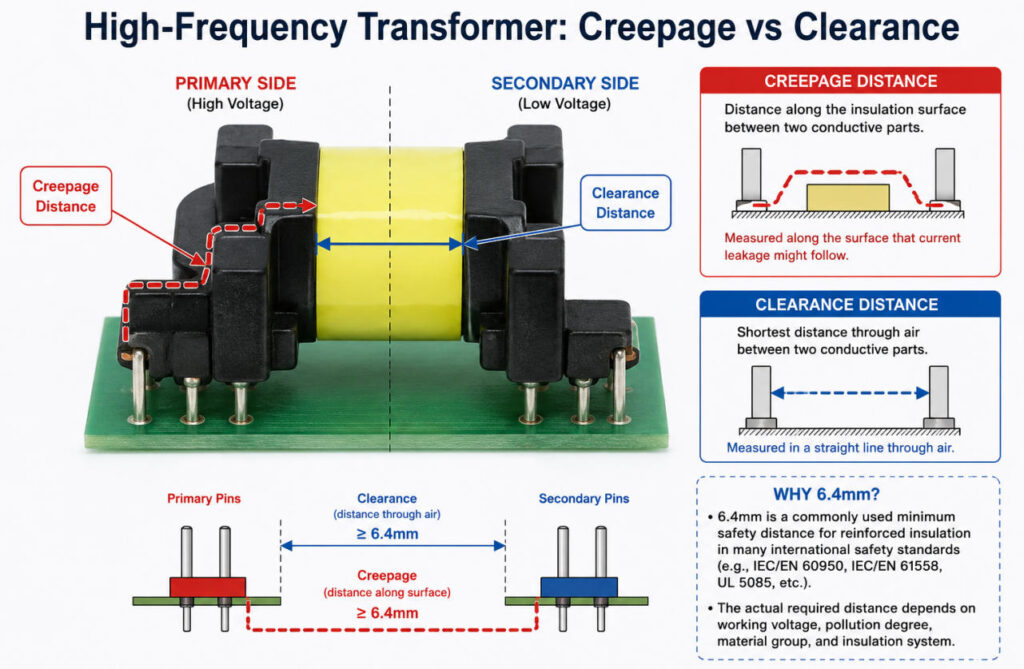
Before discussing the design methods, I want to explain two important safety concepts: “creepage distance” and “clearance distance”. These distances help prevent electrical breakdown between the primary and secondary circuits and are critical for transformer safety certification.
Creepage Distance: Distance Along the Insulation Surface
Creepage distance is the shortest path measured along the surface of an insulating material between two conductive parts. In transformers, it is typically measured along the bobbin, insulation tape, or barriers between the primary and secondary sides.
Clearance Distance: Shortest Distance Through Air
Clearance distance is the shortest distance through air between two conductive parts. If this distance is too small, electrical arcing may occur, especially during surge or hi-pot testing.
Why 6.4mm Is a Common Design Reference
For many power supply and industrial applications, 6.4mm is a commonly used safety design target between the primary and secondary circuits. Although the exact requirement depends on the applicable safety standard, designing for 6.4mm often helps reduce certification risks and improve insulation reliability.
What Design Methods Are Used to Meet Safety Requirements in High-Frequency Transformers?
To meet safety requirements, I do not rely on only one insulation method. In real transformer design, creepage and clearance distances are usually controlled by a combination of bobbin structure, pin layout, wire selection, insulation tape, sleeves, and protective parts. Below are 8 practical design methods I often use in high-frequency transformers.
Design 1. Split Primary and Secondary Pins
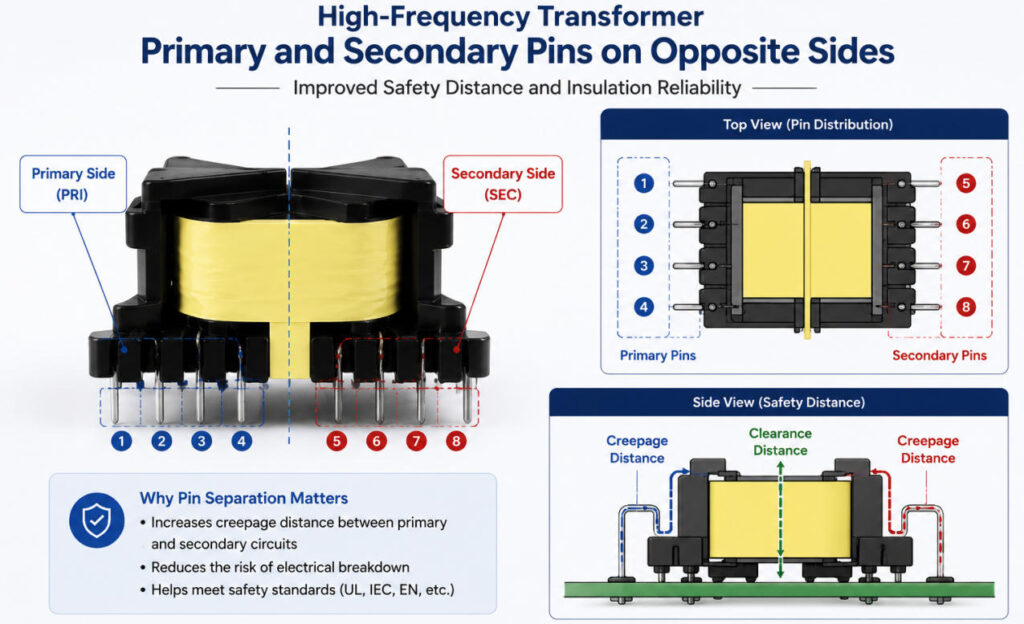
Place Primary and Secondary Pins on Opposite Sides of the Bobbin
One common method is to place the primary pins and secondary pins on different sides of the bobbin. This structure is widely used in EE, EF, EPC, ER, EP, PQ, and POT transformers.
Reduce the Risk of Insufficient Pin-to-Pin Safety Distance
When the pins are separated, it is easier to meet the required safety distance between the primary and secondary circuits. This helps reduce certification risks from the beginning of the design.
Design 2. Use High Bobbin Barriers
Increase the Distance Between Pins and Windings
A higher bobbin barrier can increase the distance between the pin area and the winding area. This is useful when the winding is close to the terminal pins.
Improve Insulation Reliability Without Changing the Winding Structure
By improving the bobbin structure, the transformer can achieve better insulation protection without making major changes to the winding design.
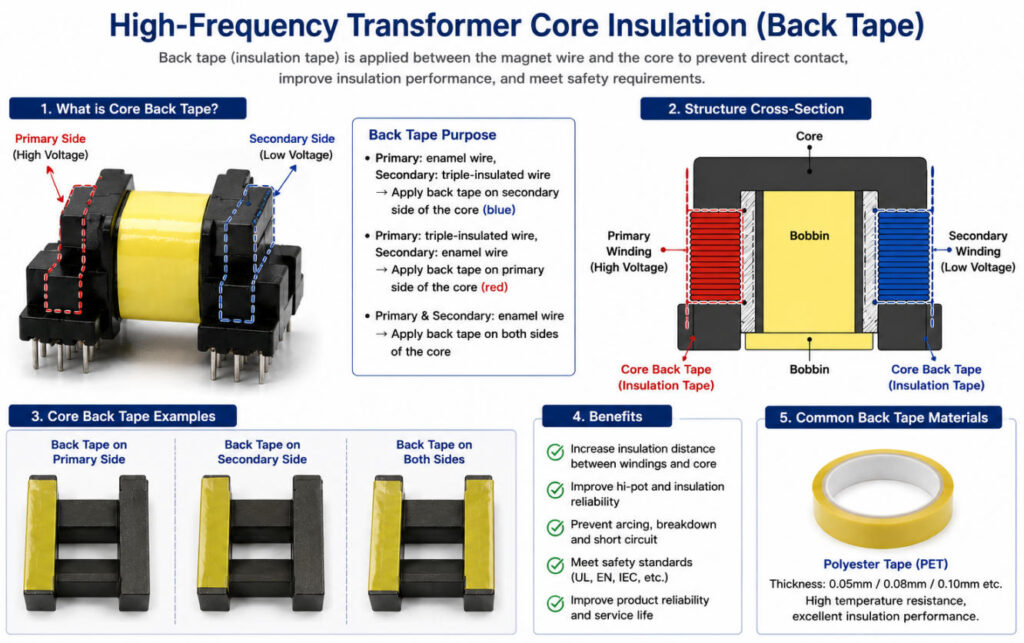
Design 3. Apply Magnetic Core Insulation Tape
Isolate the Magnetic Core from Windings
In some designs, the magnetic core may be too close to the winding or pins. Applying insulation tape to the core can help separate the core from the winding system.
Decide Which Side Needs Tape According to Wire Type
If the primary uses enamelled wire and the secondary uses triple-insulated wire, I may apply tape on the secondary side of the core. If both sides use enamelled wire, both sides may need insulation tape.
Design 4. Use Safety Bobbins
Increase Distance Between Secondary Pins and Winding Area
Safety bobbins are designed to provide more space between the winding area and the secondary pins. This helps improve creepage and clearance.
Support Safer Designs When Triple-Insulated Wire Is Used
When triple-insulated wire is used, a safety bobbin can further improve insulation protection and reduce the need for extra sleeving in some designs.
Design 5. Use Triple-Insulated Wire
Improve Insulation Between Primary and Secondary Windings
Triple-insulated wire is often used on either the primary or secondary side to improve insulation between windings. It is especially useful in compact high-frequency transformers.
Reduce the Need for Large Margin Tape in Compact Designs
Compared with traditional margin tape designs, triple-insulated wire can save winding space and improve production efficiency.
Design 6. Add Insulation Sleeves
Protect Lead Wires During Soldering
During soldering, the insulation layer of the wire may be damaged by heat. Adding insulation sleeves can protect the lead wires near the pin area.
Prevent Insulation Damage Near Pin Terminals
Sleeves help maintain safety distance and reduce the risk of hi-pot failure caused by damaged wire insulation.
Design 7. Increase Insulation Tape Layers
Use Multiple Tape Layers Between Primary and Secondary Windings
Between primary and secondary windings, I usually use multiple layers of insulation tape to improve dielectric strength.
Prevent Puncture and Improve Dielectric Strength
Extra tape layers help prevent puncture, reduce insulation failure risk, and improve long-term reliability.
Design 8. Use Protective Covers
Wrap or Shield the Magnetic Core Area
When the product height is limited, a protective cover can be used to wrap or shield the magnetic core area.
Meet Safety Distance Requirements When Product Height Is Limited
A protective cover helps maintain safety distance without increasing the transformer height too much. It is a practical solution for compact power supplies.
How to Choose the Right Safety Design Method
There is no single safety design method that works for every high-frequency transformer. The best solution depends on the application’s electrical requirements, mechanical constraints, certification targets, and cost expectations. In my experience, successful transformer design is about combining the right insulation methods to achieve both safety compliance and practical manufacturability.
Consider Transformer Size and Height Limits
Physical space is often the first factor that influences safety design choices.
If the transformer has sufficient height available, I may choose higher bobbin barriers, safety bobbins, or protective structures to increase creepage and clearance distances. These solutions are usually reliable and easy to implement.
However, many modern applications require compact transformer designs. In products with strict height restrictions, such as smart meters, industrial controllers, and compact power supplies, increasing the physical dimensions is often not possible. In these situations, methods such as triple-insulated wire, magnetic core insulation tape, or protective covers become more practical solutions.
The available space should always be evaluated before selecting the insulation strategy.
Consider Wire Type, Power Level, and Certification Standard
The choice of insulation method should also match the transformer’s electrical design.
For example, transformers using triple-insulated wire can often achieve reinforced insulation requirements more easily than designs that use enamelled wire on both primary and secondary windings. If both sides use enamelled wire, additional insulation measures such as margin tape, insulation barriers, or increased tape layers may be required.
Power level is another important consideration. Higher-power transformers typically require larger winding windows and stronger insulation structures because higher operating voltages and currents can create greater electrical stress.
In addition, the target certification standard must always be considered during the design phase. Requirements may vary depending on whether the transformer is designed to comply with IEC 62368-1, IEC 61558, UL 5085, medical safety standards, or other industry-specific regulations. Understanding these requirements early can help avoid costly redesigns later.
Balance Cost, Efficiency, and Long-Term Reliability
Safety is essential, but the most expensive solution is not always the best solution.
Some methods, such as magnetic core insulation taping or complex folded insulation structures, may increase labor costs and create production consistency challenges. Other methods, such as safety bobbins or triple-insulated wire, may have higher material costs but improve manufacturing efficiency and reliability.
When selecting a safety design method, I always look beyond certification approval. The design should also support stable mass production, maintain electrical performance, and provide reliable operation throughout the product’s service life.
The ideal solution is one that meets safety requirements, controls manufacturing costs, maintains production efficiency, and delivers long-term reliability for the end user.
How Unicreed Supports Safety-Compliant Transformer Design
At Unicreed, safety is built into every stage of transformer development. We understand that passing safety certification is not only about meeting electrical specifications—it also requires careful attention to insulation design, material selection, and manufacturing quality. By combining engineering experience with strict quality control, we help our customers reduce certification risks and improve product reliability.
Custom Bobbin and Winding Design
Different applications have different safety requirements. That is why we do not rely on a one-size-fits-all approach.
Our engineering team can develop custom bobbin structures and winding arrangements based on the customer’s voltage level, insulation requirements, available installation space, and target safety standards. We can optimize pin layouts, safety margins, winding separation, and insulation structures to help achieve the required creepage and clearance distances.
Whether the application is a power supply, industrial controller, smart meter, medical device, or renewable energy system, we work closely with customers to develop a transformer design that balances safety, performance, and manufacturability.
Material Selection for Insulation Reliability
The reliability of a high-frequency transformer depends heavily on the quality of its insulation materials.
At Unicreed, we carefully select insulation materials that meet international safety requirements. These include UL94V-0 flame-retardant bobbins, high-quality insulation tapes, triple-insulated wires, insulating sleeves, and certified ferrite core insulation materials. Our products are designed with Class B insulation systems and use materials that provide stable electrical and thermal performance under long-term operating conditions.
By choosing proven insulation materials, we help reduce the risk of dielectric failure, insulation aging, and safety-related product issues throughout the transformer’s service life.
Hi-Pot Testing and Quality Inspection Before Shipment
A well-designed transformer must also be verified through rigorous testing.
At Unicreed, every transformer undergoes strict quality control procedures before shipment. Our production process includes 100% electrical parameter testing, 100% semi-finished product inspection, 100% high-potential (Hi-Pot) testing, 100% finished product testing, and 100% appearance inspection. These inspections help ensure that each transformer meets both performance and safety requirements before reaching the customer.
In addition, we maintain traceable production records and perform ongoing quality monitoring to support consistent manufacturing quality. This commitment helps our customers achieve smoother certification processes and greater confidence in their final products.
Conclusion
Safety compliance starts during the transformer design stage. Features such as pin layout, bobbin structure, insulation materials, and winding methods all play an important role in meeting creepage and clearance requirements.
The right safety design can help reduce certification risks and improve long-term reliability. By selecting appropriate insulation solutions and verifying them through testing, manufacturers can avoid costly redesigns and product failures.
Related Transformer Articles:
- How to Improve HI-POT Performance Poor in High-Frequency Transformers?
- What Parameters Should You Consider When Selecting a High-Frequency Transformer?
- How to Choose the right transformer with your SMPS?
- How to Improve Leakage Inductance Performance in High-Frequency Transformers?
- Everything You Need to Know High-Frequency Transformer Flying Leads Wire